
Where India’s Official Medicine Data Lives: What’s Available and What’s Still Missing
Access India's Medicine API
Integrate real-time, CDSCO-aligned medicine data into your healthcare platform.
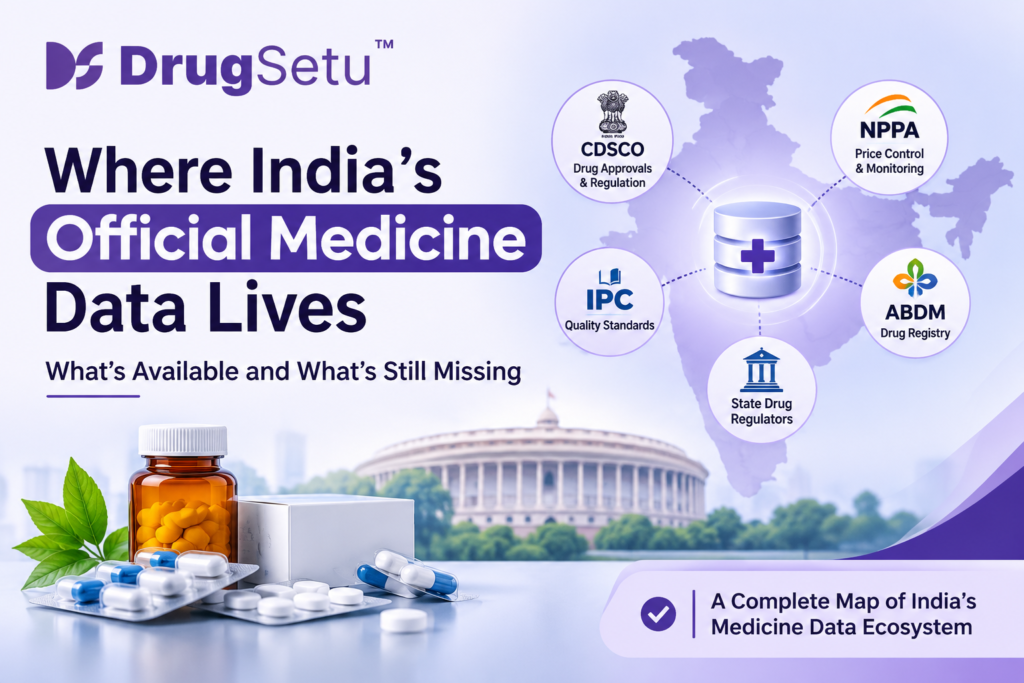
Ask five people in Indian healthcare where to find the official record of a single medicine, and you will probably get five different answers. One will say the CDSCO website. Another will name the NPPA price app. A hospital pharmacist will open their own software. A developer will ask whether there is an API.
Nobody in that conversation is wrong. Medicine data in India is spread across several public bodies, and each one holds the piece that matches its job. This post is a plain map of who holds what, where the gaps still are for anyone building an Indian medicine database, and why those gaps are easier to close when everyone works from the same catalogue.
A quick map of the sources
- CDSCO (Central Drugs Standard Control Organisation). The national regulator for approvals and licences. Its SUGAM portal handles applications, and it publishes a monthly list of drug samples that failed quality tests. For July 2026 alone, 280 samples were flagged as not of standard quality or spurious.
- NPPA (National Pharmaceutical Pricing Authority). Fixes and monitors the prices of scheduled medicines. Its Pharma Sahi Daam app lets anyone check a medicine’s price, and IPDMS 2.0 is where companies file their price forms.
- IPC (Indian Pharmacopoeia Commission). Publishes the official quality standards for medicines. The tenth edition, IP 2026, is out, and IPC also runs the country’s drug-safety reporting programme, PvPI.
- State drug regulators. Issue manufacturing and sale licences. The Online National Drugs Licensing System (ONDLS) is meant to bring this work onto one portal. Reports in late 2025 said 18 state authorities had joined, and in September 2026 the Drugs Consultative Committee was still urging the remaining states to onboard.
- ABDM Drug Registry. Launched on 29 June 2026 by the Union Health Minister and built with CDSCO and the National Resource Centre for EHR Standards (NRCeS). At launch it covered more than 1,23,000 branded drugs, over 10,000 generic drugs and over 29,000 substances.
Different jobs, different shapes of data
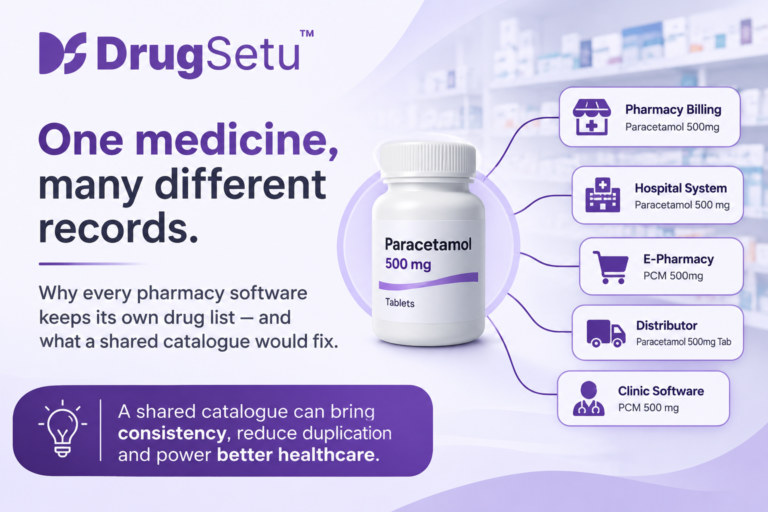
None of this is a design flaw. A body that approves drugs, one that caps prices and one that writes quality standards are asking different questions, so they publish different things in different forms. The trouble starts when a developer needs all of it at once, in a form a program can read. That is the core challenge of pharma data management in India: the data exists, but not in one structured place.
Take price ceilings. They are notified through official orders that list formulations in tables, and manufacturers then issue their own price lists. That works well for people. It is harder for software that has to compare a price against a specific product in a pharmacy’s stock.
Where software still runs into gaps
- Documents made for reading, not for systems. Orders, notices and lists are easy for a person to scan, but not always easy for a program to ingest and keep current. This is why teams look for a medicine database API instead of parsing PDFs.
- State-level rollout is still in progress. Licensing data sits with state authorities, and ONDLS adoption is still growing.
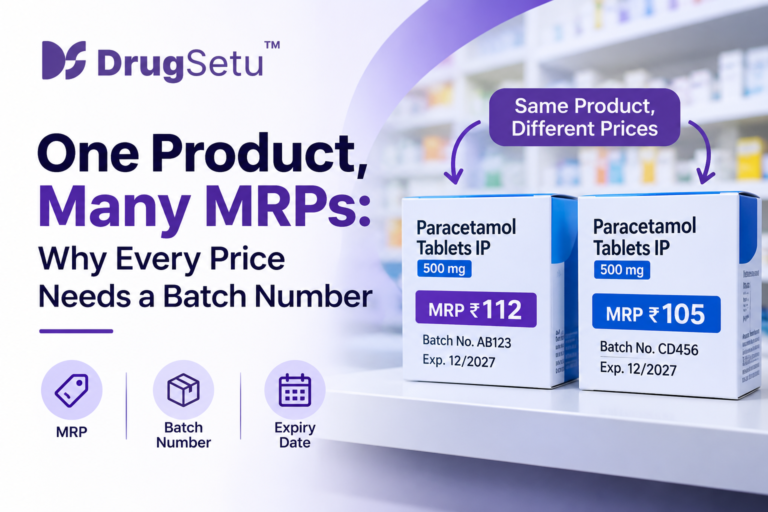
- Batch-level facts sit with manufacturers. Which batch carries which printed price is known to the company that made it and the shop that bought it, not to any public list.
- Everyday product details. Pack photos, display names and similar details that apps and shops need are outside what regulators are asked to publish. Platforms usually have to assemble these themselves.
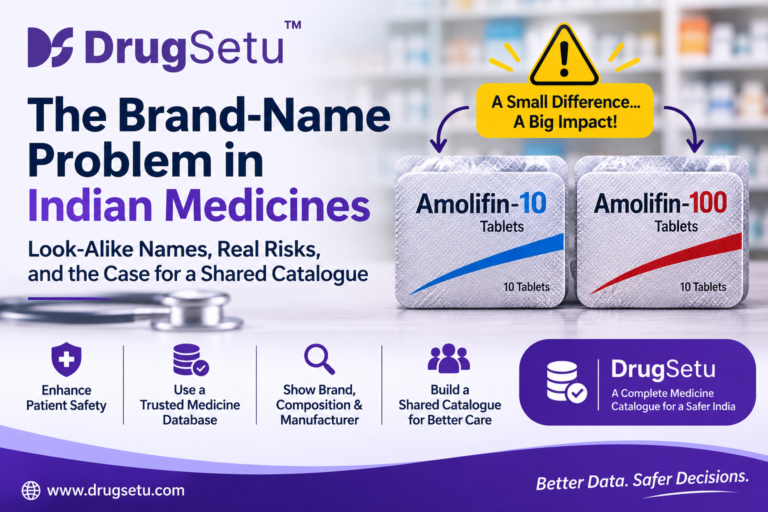
- Generic and brand mapping. Pharmacies and apps that need a generic medicine database India still end up stitching brand names, salts and substances together on their own.
The direction is encouraging
The public side is moving fast. The Drug Registry gives the country a shared way to identify medicines. QR-code rules under Schedule H2 are being extended to vaccines, anti-cancer drugs, narcotics and antimicrobials. CDSCO has also announced plans to replace its decade-old SUGAM portal with a new open-architecture platform, and its call for a digital regulatory system speaks of open standards.
Where DrugSetu fits
DrugSetu is an initiative to bring the Indian medicine catalogue together in one uniform, API-ready form, a single drug database India that developers can build on. It is not a regulator, not a government database and not a replacement for any source above. When a legal question comes up, whether it is an approval, a ceiling price or a quality standard, the regulator’s own record is the one to rely on.
What we are trying to do is narrower: give platforms one consistent catalogue, a medicine API India teams can plug into, built to stay in step with these public standards as they develop.
Official medicine data is spread across bodies with different jobs, and that is by design. The gap for software is format and consistency. A shared catalogue helps close it without replacing anything.
Next step: Building a healthcare product? Explore the DrugSetu API or write to info@drugsetu.com.
Sources and further reading
- PIB: Union Health Minister launches Drug Registry (29 June 2026)
- NPPA: Pharma Sahi Daam
- NPPA: IPDMS 2.0
- ETV Bharat: CDSCO flags 280 drug samples as NSQ or spurious in July (21 Aug 2026)
- Minutes of the 70th Drugs Consultative Committee meeting (18 Sept 2026)
- ONDLS portal: About us
- Digital Health News: CDSCO to replace SUGAM portal
- Indian Pharmacopoeia Commission: IP Online