

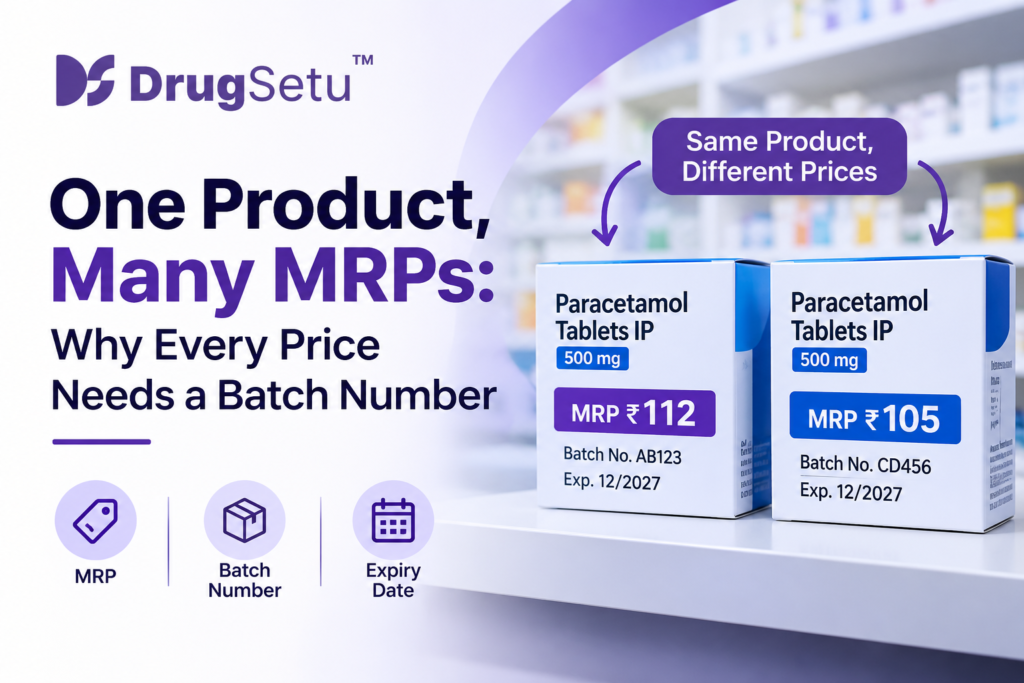
One Product, Many MRPs: Why Every Price Needs a Batch Number
Quick answer
An MRP belongs to a batch, not just to a product. After the GST change of 22 September 2025, packs with old and revised MRPs sat on the same shelves, and tax changes or yearly revisions keep creating new batches with new prices. A catalogue that links the price to the batch number, expiry date and effective date keeps e-pharmacies, billing systems and insurers in step with what is printed on the pack.
Access India's Medicine API
Integrate real-time, CDSCO-aligned medicine data into your healthcare platform.
A customer hands over a strip of tablets and asks why the price printed on it is different from what a pharmacy app showed last week. Both numbers exist for a reason.
To see why, you have to look at where a medicine’s price actually lives. Most listings in an Indian medicine database store one price against each product. That works on a quiet day. It stops working the moment the price on the pack changes, because the pack in the customer’s hand may belong to an older batch than the one the app knows about.
The shop is not wrong. The app is not wrong either. Each one is showing a real price, just for a different batch. The gap sits in the data, not in the people using it.
The price is printed on the pack
In India, the maximum retail price (MRP) is printed on the pack and includes all taxes. So when a tax rate or a price ceiling changes, the new price reaches the market through new batches. Older batches that are already in warehouses and on shelves still carry the old printed MRP.
When the change is a tax cut, the rules also ask that the benefit reaches the customer, so shops work from revised price lists alongside what is printed on older packs. A shopkeeper therefore holds two sources of truth at once: the number on the strip and the number on the latest price list.
This means a single medicine database entry can be correct for one batch and wrong for the next, even though the product name, strength and company have not changed at all. The product is the same. The price depends on when the batch was printed.
What happened in September 2025
The GST Council’s 56th meeting, held on 3 September 2025, lowered GST on many drugs and formulations from 22 September 2025. NPPA directed manufacturers and marketing companies to revise MRPs accordingly so the benefit would reach patients.
Relabelling stock that was already in the market was not made mandatory, because it could disrupt supply. Instead, revised price lists and supplementary price lists were to be issued and displayed. Companies published notices saying that packs with both the old and the revised MRP might be in the market during the transition.
Here is a simple way to picture it.
| Item | Older batch (GST 12%) | Newer batch (GST 5%) |
|---|---|---|
| Base price | ₹100 | ₹100 |
| GST | ₹12 | ₹5 |
| Printed MRP | ₹112 | ₹105 |
Illustrative example: base price ₹100, GST falling from 12% to 5%. Numbers are for explanation only.
Both strips can sit on the same shelf, from the same company, with the same name. A pharma database India teams depend on has to describe both of them correctly, and a single price field cannot do that.
It is not only GST
For scheduled medicines, NPPA also allows MRPs to be revised each year in line with the Wholesale Price Index. In March 2025, for example, it announced that manufacturers could raise MRPs of scheduled formulations by 1.74 per cent. Every revision like this starts a new generation of batches with new prices.
Seen over a few years, this is normal. Tax changes, yearly revisions and company decisions keep producing new batches with new prices. Handling this well is a core part of pharma data management, not an occasional exception. A system that only copes with price changes when someone remembers to update a spreadsheet will always be a little behind the shelf.
Why one price per product breaks down
- E-pharmacy listings. A page shows one MRP while the pack that arrives carries another, and the customer sees a mismatch. Even when the listing is accurate for one batch, the customer has no way to know which batch will arrive.
- Hospital and pharmacy billing. Staff must pick the right price for the batch in hand, often by hand. On a busy counter, that is one more small decision that can go wrong.
- Insurers and TPAs. Checking a billed amount against a single listed price can raise queries that did not need to exist. A claim may look inflated only because the batch was printed before the price changed.
- Analytics. Price trends become muddy when batches printed at different times are treated as one. Anyone building an Indian medicine dataset for research or reporting runs into this quickly, because the average price of a product mixes batches that were never meant to be compared.
In each case the root problem is the same. The system holds one price for a product, while the real world holds several, one for each batch.
What “batch-mapped price” means
Instead of storing a single price against a product, the catalogue keeps a small chain of facts:
- The product
- The batch number
- The expiry date
- The MRP printed on that batch
- The date from which that price applies
With that chain in place, a price is always tied to the pack it belongs to. The question changes from “what is the price of this medicine?” to “what is the price printed on this batch?”, which is the question a customer, a billing clerk and an insurer are all really asking.
This is also why a medicine barcode database becomes more useful when batch details are attached. A scan can then lead not just to the right product, but to the right price for the pack in hand. A modern drug database India teams can rely on should hold this chain, not just a list of names and a single price.
Who knows this best
The company that made the batch. It decides the printed price, it knows the batch number, and it knows the expiry date. No distributor, app or billing vendor can know these facts earlier or more accurately.
This is why DrugSetu’s second phase is built around a dashboard where pharmaceutical companies manage their own product data, including batch numbers and prices, with updates reflected in real time. That dashboard is in development and has not yet been released.
Once company-managed data is in place, software teams can pull it through a drug database API instead of maintaining their own price lists. A good drug information API should return the batch, the expiry and the printed MRP together, so that billing, e-pharmacy and insurance systems all see the same thing. For teams who think of it as one shared Indian drug database, a correction made once at the source reaches every platform that uses it.
What software teams should check
If you build or buy pharmacy, hospital or e-pharmacy software, a few questions are worth asking about any drug database you plan to use.
- Can it store more than one price for the same product?
- Does each price carry a batch number and an effective date?
- Is the source of each price clear, ideally the company that made the batch?
- Can you see what changed and when, so that a price dispute can be traced?
A pharma database that answers yes to these questions will cope with the next tax change or price revision without a scramble. One that answers no will need manual fixes every time the rules move.
An honest note on scale
We have not come across a published figure for how many batches in the market carry different prices from one another. What is clear is that differences appear whenever there is a tax change or a price revision. The point is not how often it happens. It is that a catalogue should be able to handle it cleanly when it does.
Key takeaway: An MRP belongs to a batch, not just to a product. Catalogues that link price to batch number keep every platform in step with what is actually printed on the pack.
Pharmaceutical company? Ask for early access to the DrugSetu product dashboard at drugsetu.com/contact-us. Software teams that want to build on a medicine database API or medicine API India can talk to us too.