
The ABDM Drug Registry and the Catalogue Layer Around It
Access India's Medicine API
Integrate real-time, CDSCO-aligned medicine data into your healthcare platform.
On 29 June 2026, the Union Health Minister launched the Drug Registry under the Ayushman Bharat Digital Mission (ABDM). For anyone who builds or runs healthcare software in India, it is one of the most useful announcements in years. It matters especially for teams working on pharma data management and for anyone who has ever tried to maintain an Indian medicine database of their own.
This post explains what the registry is, based on the Ministry’s own release. Then it looks at a quieter question: once medicines have a shared identity, what else does a platform need to run day to day? The answer says a lot about how India’s digital health stack is likely to grow, and about where the next layer of useful work sits.
What the Drug Registry is
- It is the fourth core registry under ABDM, alongside the ABHA registry for individuals, the Healthcare Professional Registry and the Health Facility Registry.
- It was built with CDSCO and the National Resource Centre for EHR Standards (NRCeS), Pune, using international standards such as SNOMED CT.
- It carries standardised codes for generic (clinical) drugs, branded medicines and substances, which makes it a major step for any generic medicine database India effort.
- At launch it listed more than 1,23,000 branded drugs, over 10,000 generic drugs and over 29,000 substances.
- Users can search this drug index by generic name, brand name, substance or manufacturer.
- It is designed to connect with hospital management systems, e-prescription platforms and doctor-facing apps through open APIs. A portal and a sandbox for testing are available.
Taken together, these points show a clear design intent. The registry is meant to be a common reference that many different systems can plug into, not a single application that people log in to and use on its own. Open APIs and a sandbox tell developers that the expected users are other pieces of software.
Why it matters
The Ministry describes the problem clearly: across Indian healthcare systems, the same drug is often written with different names and formats. That leads to duplication, data-entry errors and systems that cannot talk to each other. A shared registry goes after the root of that.
Think of it as giving every medicine an agreed identity. When a hospital, a doctor’s app and a pharmacy all point to the same code, they are at least talking about the same thing.
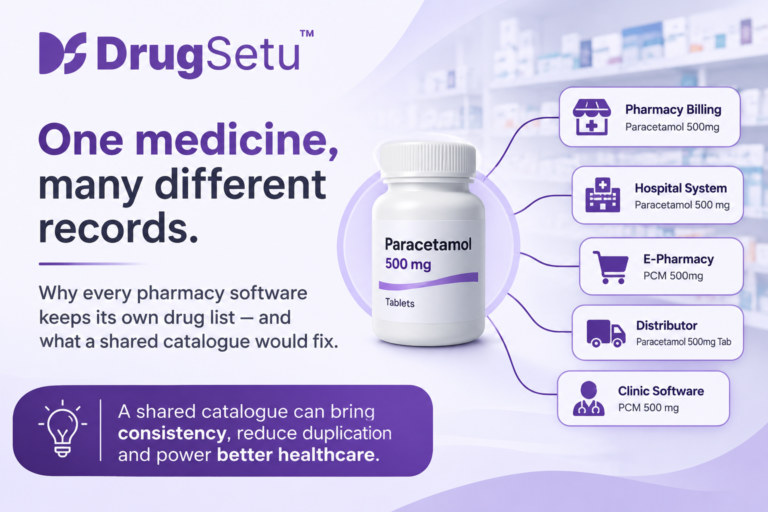
Anyone who has tried to maintain an A to Z medicine name list or an all medicine name list by hand knows how quickly the trouble starts. One source writes a strength with a space, another without. One lists a brand with its dosage form, another leaves it out. Two spellings of the same salt end up as two separate rows, and nobody notices until a report or a claim does not add up. A common medicine index removes much of that pain, because the question “are these two entries the same drug?” now has an agreed answer.
For the wider health system, the benefits go beyond tidier spreadsheets. Shared codes make it easier to exchange prescriptions between systems, to compare records across facilities and to build features that depend on knowing exactly which substance a patient was given. These are the things a registry is built to enable.
Identity is one job. Running a shop is another.
Knowing what a medicine is, its generic name, its substance and its brand, is the first step. A pharmacy, an e-pharmacy or an insurer needs more on any given day: this exact pack, this strength, how it should look on screen, what it costs, which batch is on the shelf.
Hospitals face the same thing. A hospital that maintains a drug formulary needs it to match what is actually available, in the packs that suppliers actually deliver. A code tells you which medicine is meant. It does not tell the pharmacy counter whether the strip in front of them is the one on the screen.
The launch release describes search by generic name, brand, substance and manufacturer. It does not list fields such as price, pack images or batch details, which have traditionally been held by manufacturers, distributors and retailers. Platforms should always check the registry’s own documentation for its current field list, because it is a new and evolving system.
None of this is a shortcoming. A coding registry is meant to be lean and stable. Codes need to change slowly and carefully, because many systems depend on them. Prices, batches and pack details change constantly. Keeping those two kinds of data in one place would make the stable part less stable, so it is sensible that they are treated as different jobs.
That difference is also what separates a coding registry from a full medicine database or a pharma database India offering. One tells you what a thing is. The other helps you sell it, show it, check it and reconcile it.
Who feels the gap most
The people who notice the difference between identity and catalogue are usually those closest to daily operations.
Pharmacy software teams need product records that look right on a billing screen and a mobile app. E-pharmacies need clear listings that customers can recognise. Insurers and third-party administrators need to match what was dispensed against what was prescribed. Hospital IT teams need item masters that stay consistent across departments. Health-tech start-ups need a starting dataset, so that their first months go into building features rather than cleaning data.
Today, many of these teams build their own lists. They scrape, copy, merge and correct, and then they repeat the exercise when something changes. The work is repeated across hundreds of organisations, and each copy drifts slightly from the others. Even teams that look for an india medicine database or a drug database India to start from often find that they still have to reconcile several sources before they trust the result.
The scope conversation is still going
When the National Health Authority published its consultation paper on the registry in 2022, it proposed bringing drug information in from several sources, including CDSCO, state regulators and manufacturers. According to MediaNama’s coverage of the stakeholder meeting that followed, one participant argued for including pricing as well.
That the question came up at all shows how much sits around the core. It also shows that the boundary of a national registry is a matter of design choice and ongoing discussion, not a fixed line. The registry may well grow, and platforms should keep an eye on its documentation. Whatever it eventually carries, a lean coding layer and a practical product layer will probably keep serving different needs.
A catalogue layer that stays aligned
This is where we see a role for a shared catalogue: a layer that holds the practical product details platforms use every day, and that is built to stay in step with public standards like the Drug Registry rather than compete with them. Think of it as a ready-to-use Indian drug database and Indian medicine dataset that developers do not have to compile on their own.
The standards remain the reference. The catalogue helps platforms put those standards to work without each one building its own list from scratch. DrugSetu is working on this: one uniform catalogue that software can search through an API, with manufacturers later updating batch numbers and prices themselves.
That last part is important. Manufacturers are the original source of much of this information. When they can update batch numbers and prices directly, the data does not have to pass through several hands before it reaches the platform that needs it. Fewer hand-offs mean fewer chances for errors to creep in.
For developers, the practical result is a single drug database API or drug information API instead of many scattered sources. Teams searching for a medicine API India, an Indian medicine database API or simply an API for medicine database integration can start from one place. The same applies to anyone comparing a general drug database or medicine database API with the registry. The comparison is less about which is better and more about which job each one does.
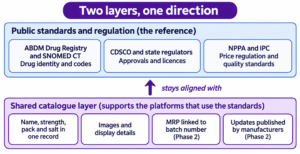
Two layers, one direction
The simplest way to picture the arrangement is as two layers moving the same way.
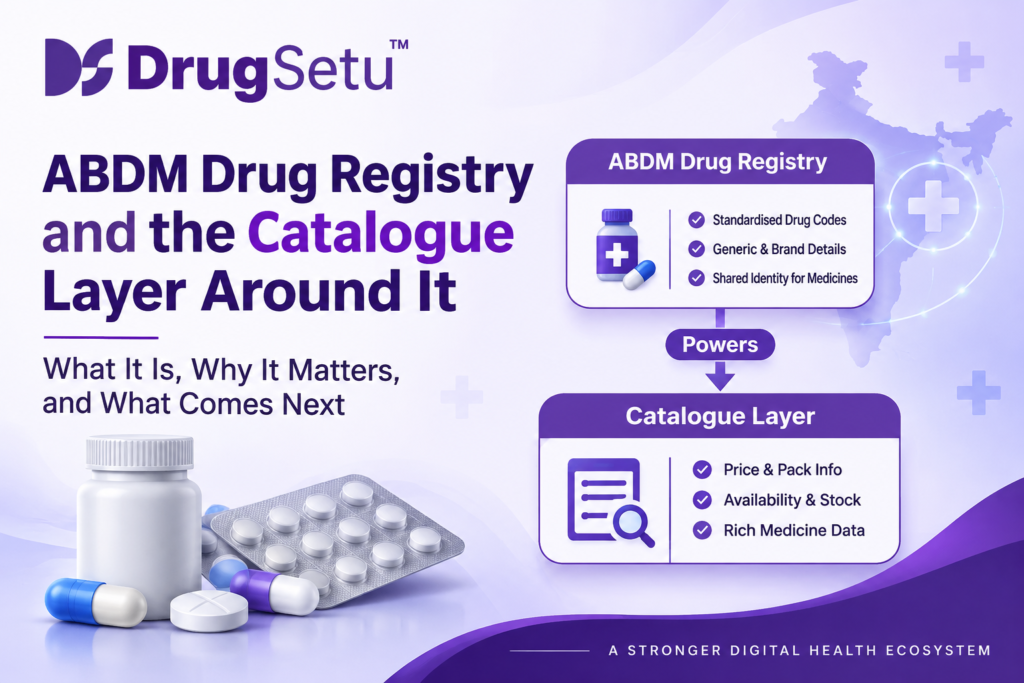
The first layer is public and shared: the Drug Registry, with its standard codes for generic drugs, brands and substances. It answers the question “what is this medicine?” in a way every system can agree on.
The second layer is practical and detailed: a catalogue that carries the product-level information platforms use daily, and that points back to the standard identity. It answers the question “what exactly is on my shelf, and what should my screen show?”
Neither layer replaces the other. A platform that uses only the first may find that it still has to build everything else. A platform that uses only the second risks drifting away from the standard that the rest of the health system is adopting. Used together, they let a platform speak the shared language of ABDM while still running a normal business.
Public standards stay the reference. A shared catalogue layer supports the platforms that use them.
What platforms can do now
If you build or run healthcare software, a few steps make sense today. Read the registry’s documentation and try the sandbox, so you know exactly which fields it offers. Map your own product records to its codes where you can, so that your data is ready as adoption grows. Decide which details your platform needs that a coding registry is not designed to hold, such as price, pack and batch. And plan to source those from a shared catalogue rather than from a list you have to maintain alone.
Key takeaway: The Drug Registry gives medicines a shared identity. A catalogue layer helps platforms with everything else they need on a normal working day. They work best together.
Next step: Check the official registry at drugregistry.abdm.gov.in. To see how a shared catalogue could work alongside it, visit drugsetu.com.