
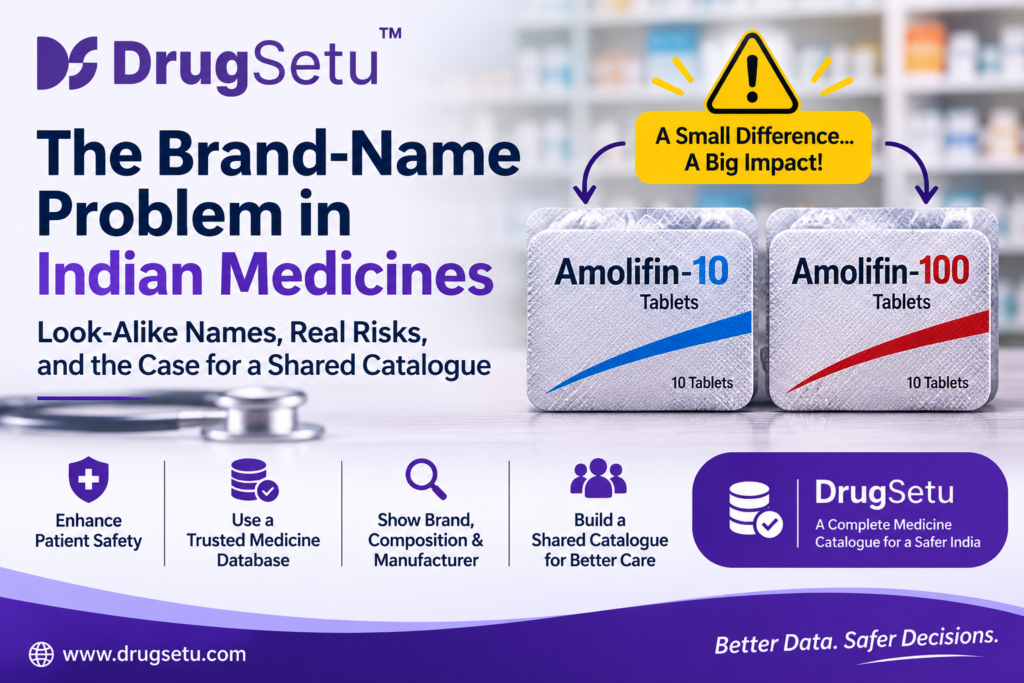
The Brand-Name Problem: Look-Alike Names and the Case for a Shared Catalogue
Quick answer
Look-alike and sound-alike medicine names are a known patient-safety risk, and India has little data on the errors they cause. The Drugs and Cosmetics (Thirteenth Amendment) Rules, 2019 ask companies to self-check for similar names before launching a brand, but no single database lists every brand name to check against. A shared catalogue that shows brand, composition, strength, form and manufacturer together makes look-alike products easier to tell apart at the moment it matters.
Access India's Medicine API
Integrate real-time, CDSCO-aligned medicine data into your healthcare platform.
A medicine strip is small. The name on it is often smaller. In a busy pharmacy at the end of a long shift, two names that look or sound alike can be mixed up, and the cost of that is not a billing error. It is a patient receiving the wrong drug. That is why teams working on pharma data management increasingly treat brand names as safety data, not just labels on a screen.
Behind every search box in a pharmacy app, a hospital system or an e-pharmacy sits some kind of product list. How that list is built, and how well it shows the differences between similar products, decides whether the software helps a careful person or quietly makes a mistake easier.
A long-known issue
Look-alike, sound-alike medicine names are a recognised patient-safety concern around the world. In India, published commentary on the issue has pointed out that identical or very similar brand names have been used for different drugs, and that the country has little data on prescription errors.
That second point deserves attention. When there is little data on errors, it is hard to know how often confusion happens, which names cause it and where it is most likely. Problems that nobody measures tend to stay invisible. Anyone who has tried to maintain an A to Z medicine name list for a pharmacy knows how easily two entries that differ by a single letter can sit next to each other for years, each one looking perfectly normal on its own.
The risk is also not limited to the counter. A doctor typing a prescription, a nurse reading a ward list and a patient picking up a refill are all working with names. Any one of them can be the person who reads one name and means another.
What the rules ask for
The Drugs and Cosmetics (Thirteenth Amendment) Rules, 2019 asked companies to check for similar names before launching a brand. According to one published explainer, that check covers the trademarks registry, a CDSCO database of brand names, reference books on formulations and the internet, and the company gives an undertaking. It is a self-check, and the same explainer notes there has been no single database listing every pharmaceutical brand name to check against.
DEVELOPER NOTE (delete before publishing): The description of the 2019 rules comes from a secondary explainer (Rau’s IAS). Please confirm the wording against the text of the rules before publishing.
Think about what that means in practice. A company that wants to do the right thing has to search several places, each with its own format and its own gaps. A company that is in a hurry has an easy way to do less. Neither is a criticism of the rule. It is simply the natural result of asking people to check against a list that does not yet exist in one place. A reliable medicine database that anyone can query would make the check faster and more consistent, whoever is doing it.
Why a shared list matters
A rule that asks companies to avoid confusing names works best when there is a reliable place to check. The Drug Registry, which already lists more than 1,23,000 branded drugs alongside generic names and manufacturers, is a welcome step in that direction. A shared and growing view of brands is something regulators, companies, pharmacists and software teams all benefit from.
For a platform, the value of a shared view is practical. Instead of each team collecting names on its own, everyone can start from the same reference and add what they need on top. A common medicine index also makes it possible to ask useful questions across the whole market, such as which brands are nearly identical to each other, or which names are used by more than one company.
It also helps smaller teams. A start-up building a pharmacy app rarely has the time to compile and clean an Indian medicine database from scratch. Starting from a consistent source means the first months go into building the product rather than fixing spellings.
Why names are harder to manage than they look
A brand name seems simple until you try to store it. The same product may appear with the strength in the name or outside it. A brand may be sold in several strengths, several forms and several pack sizes, and each combination is a different product with the same name at the front. Companies rename products, merge them or stop selling them. Old names stay in old records long after they have left the shelf.
All of this means a name is a weak identifier on its own. Two very different products can share nearly the same name. One product can appear under several slightly different spellings. A drug index that treats the name as the whole truth will eventually mislead someone. The safer approach is to treat the name as one field among several, and to always keep the others visible: composition, strength, form, manufacturer and pack.
Hospitals feel this too. A drug formulary has to say clearly which exact product is approved, not just which name. If the formulary and the pharmacy shelf use different names for the same thing, or the same name for different things, the gap is where mistakes happen.
How good catalogue data helps at the counter
Software cannot replace the judgement of a pharmacist or doctor. What it can do is put the right facts side by side, so that judgement has something solid to work with. A well-built Indian drug database supports that in a few simple ways:
- Show brand, composition, strength, form and manufacturer together on one screen. When the salt and the maker sit next to the name, a wrong pick is easier to spot.
- Flag products whose names are nearly identical, so someone takes a second look. A small visual cue at the right moment costs very little.
- Keep names current when brands are renamed or discontinued. Stale records are a quiet source of confusion.
- Make search forgiving about spelling, but never let it silently pick one product over another. Forgiving search is helpful only when the person stays in control of the final choice.
Teams that need this kind of structure often look for an Indian medicine dataset or an all medicine name list to begin with. A flat list of names is a start, but the real safety value comes from the fields around the name.
A short checklist for product teams
If you build search or billing software for pharmacies, hospitals or e-pharmacies, a few habits make a real difference.
- Never match on name alone. Combine brand, strength, form, manufacturer and pack size. A name by itself is not enough to identify a product.
- Show the salt composition next to the brand in every search result. Composition is the fastest way to tell two look-alike names apart.
- Treat “did you mean…” suggestions as questions, not corrections. Ask the user to confirm. A silent auto-correct can turn a careful typing of one drug into a different drug.
- Log near-matches so the team can see where confusion is most likely. Over time, this builds exactly the kind of data that is missing today, and it tells you which products deserve extra warnings on screen.
For developers, a single drug database API or drug information API makes these habits much easier to follow, because the composition, strength, form and manufacturer arrive in one structured record instead of being stitched together from several sources. Teams comparing options for a medicine API India should check whether each product record carries these fields clearly, and whether near-identical names can be found easily.
Who benefits from a shared catalogue
Pharmacists get clearer screens and fewer second guesses. Hospital IT teams get item lists that match across departments. Insurers can match what was dispensed with what was prescribed more reliably. Regulators and companies get a common place to look when they check for similar names. Developers searching for an Indian medicine database API or an API for medicine database integration get one consistent source instead of many scattered ones.
None of this removes the need for human care. It makes care easier to apply, because the facts that matter are in front of the person at the moment they decide.
Key takeaway: Confusing names are a data problem as much as a naming problem. A shared catalogue makes the differences between look-alike products visible at the moment they matter.
This post is general information and not medical advice. Always follow the guidance of a doctor or pharmacist.
Next step: Want search that shows composition, strength and manufacturer together? See how the DrugSetu API structures a product record at drugsetu.com.