
Why Every Pharmacy Software Keeps Its Own Drug List
Quick answer
Almost every pharmacy billing tool, hospital system and e-pharmacy keeps its own medicine list, because each vendor needed one on day one and no shared list existed. The result is painful switching, slow reconciliation, duplicates and stale data. A shared catalogue fixes this by letting every system point to the same product record, while each platform keeps its own workflows.
Access India's Medicine API
Integrate real-time, CDSCO-aligned medicine data into your healthcare platform.
Picture a chemist in a mid-sized town who has used the same billing software for eight years. A better system comes along: cloud-based, faster, with invoices that go out on WhatsApp. She wants to switch. Then she remembers the medicine list.
Years of cleaning, renaming and adding items, all of it living inside the old software. Every local brand, every short form her staff types at the counter, every pack size she added by hand. Switching means rebuilding it, or importing it and hoping the names line up. Most of the time, they do not.
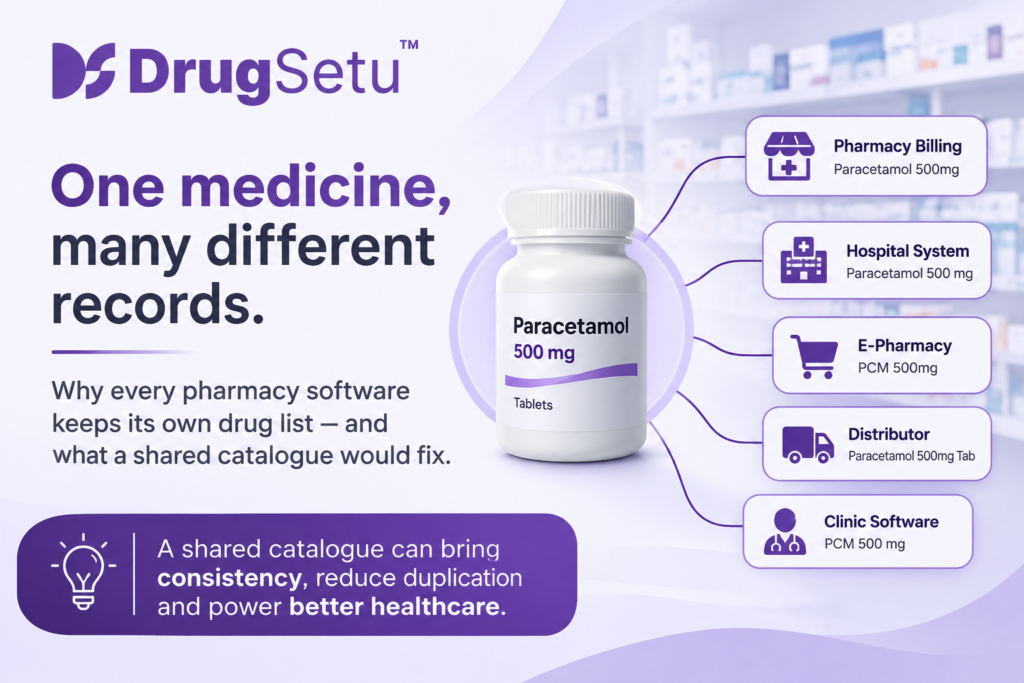
That small story plays out in many forms across India, and it points to something people outside the industry rarely see: almost every platform keeps its own Indian medicine database. Billing tools have one. Hospital systems have one. E-pharmacies, clinic apps and distributor software each have their own too. They describe the same medicines, yet they rarely agree with one another.
Everyone built their own, for good reasons
Pharmacy billing and inventory tools need a medicine database on day one. Without one, nobody could bill a single strip. So each vendor built or bought a list and started from there.
The numbers show how different these starting points are. Marg describes a medicine database of more than 4.5 lakh entries. GoFrugal advertises a prefilled database of 50,000+. Posible mentions a catalogue of over a million. These are the vendors’ own figures, and they count different things, which is rather the point: there is no single all medicine name list they all start from.
Some vendors count brands. Others count pack sizes. Others count every spelling variant a user has ever typed. A number like 4.5 lakh or one million tells you how a list was built, not how many distinct medicines exist. When every list is counted differently, comparing them, or merging them, becomes guesswork.
The same story shows up in the supply chain. When Pharmarack set out to give stockists, chemists and pharma companies a consistent catalogue, it had to bring together more than 12,000 separate, independently maintained catalogues. That is pharma data management at a very large scale, and it shows how scattered a pharma database India can be once you look beneath the surface.
None of this was careless. Each team solved a real problem with the tools and data available at the time. The trouble is that thousands of sensible local decisions, added together, produce a very fragmented picture.
What a fragmented list costs
- Switching is painful. When names and codes differ between systems, moving to new software means rebuilding the list. Many businesses stay with tools they have outgrown for that reason alone. The software may be slow or outdated, but the cost of leaving the list behind feels higher than the cost of staying.
- Reconciliation takes time. Purchase, billing and inventory records that describe the same strip in three ways have to be matched by a person. A distributor sends one name, the shop’s software shows another, and the stock register has a third. Someone has to sit down and decide they are all the same item.
- Duplicates creep in. One medicine ends up as several entries: a brand spelling, a short form, an old pack size. Over the years the list grows longer without growing more useful, and searching it gets harder instead of easier.
- Data goes stale. Every list is updated by someone, somewhere, on their own schedule. A new pack size, a changed composition or a discontinued product may reach one system months before it reaches another.
- New products start from zero. A new app or clinic software has to build or buy a list before it can do anything useful. Instead of focusing on the product, the team spends its first months on data cleaning.
Different systems, different needs
It helps to see why these lists drift apart in the first place. Each type of system uses the medicine record in its own way.
A billing tool cares about what appears on the invoice: the display name, the pack, the batch and the price. A hospital system may care more about composition and strength, because a doctor is prescribing by what is inside the medicine, not by the brand on the box. An e-pharmacy needs a clean product page, searchable names and sometimes an alphabetical A to Z medicine name list that customers can browse. A distributor cares about pack codes and what is actually in stock.
Teams who work with formularies need something different again. A hospital drug formulary is a controlled list of approved medicines, and it still has to match the products that arrive at the pharmacy counter. Others want a quick drug index or medicine index for staff who just need to look something up. Teams that scan packs at the counter or in the warehouse need a medicine barcode database so that a scan leads to the right product record every time.
Those who work on the generic side need a reliable generic medicine database India, so that a brand and its generic equivalent can be linked properly. And anyone doing analytics or research ends up wanting a clean Indian medicine dataset to work with.
All of these needs are valid. The problem is that each team usually builds a separate list to meet its own need, instead of building on a shared base.
Why not simply copy a government list?
It is a fair question, and the answer is kind to everyone involved. Public lists exist to serve regulation, identity and policy. They are not designed to power a shop counter or an app screen, where you need display names, pack details, current prices and fast search.
The Drug Registry, for example, is a major step toward a shared drug identity, and platforms will want to align with it. They will still need practical product details on top of it. A regulator’s record answers the question “what is this medicine, officially?” A shop counter also needs to know how it is sold, how it is packed and what a customer will type to find it. That is where a practical drug database India can sit alongside official records, adding the layer that daily work depends on.
The two are not rivals. One gives identity and the other gives usability, and software works best when it has both.
What a shared catalogue changes
Imagine every system pointing to the same record for the same product. Your local software can keep its own shortcuts and settings. Underneath, the product is the same everywhere. In other words, one shared Indian drug database instead of many private ones.
Illustrative only: names are examples, not taken from any specific system.
- Switching software gets easier, because the product records travel with you. The chemist from our opening story would not need to rebuild eight years of work. Her new software would simply recognise the same products.
- Fewer disputes over “which item did we mean”. When a purchase order, an invoice and a stock record all point to one record, there is nothing left to argue about.
- New apps and clinics can start with a clean list instead of building one. A small team can spend its time on features rather than data cleanup.
- A correction made once reaches everyone who uses the catalogue. Instead of fixing the same mistake in a hundred places, it is fixed at the source.
- Reporting becomes more reliable. When everyone counts the same products the same way, totals and comparisons start to make sense.
What software teams should look for
If you build or buy pharmacy, hospital or e-pharmacy software, the choice of data source matters as much as the choice of features. A few things are worth checking.
- Stable records that do not change identity every few months. If a record’s ID keeps changing, everything linked to it breaks.
- Version history, so you can see what changed and when. This matters for audits, for debugging and for trust.
- Clear ownership of each record. You should know where the information came from and who is responsible for keeping it correct.
- API access, such as a drug database API or medicine API India, so updates flow into your system without manual uploads. Spreadsheets sent by email are how lists drift apart in the first place.
- Useful depth. A good drug information API should also return pack details and product data, not just names.
These are the principles behind DrugSetu: versioned updates, a full change history, and product records that come from the companies that make the products. Whether you think of it as a drug database, a pharma database or simply a shared catalogue, the goal is the same: one agreed description of each product that every system can rely on.
Key takeaway: Every platform keeping its own list was a sensible choice at the time. A shared catalogue lets platforms keep their own workflows while agreeing on what the product is.
Next step: Run or build pharmacy, hospital or e-pharmacy software? Talk to us about the DrugSetu medicine database API and Indian medicine database API at info@drugsetu.com.