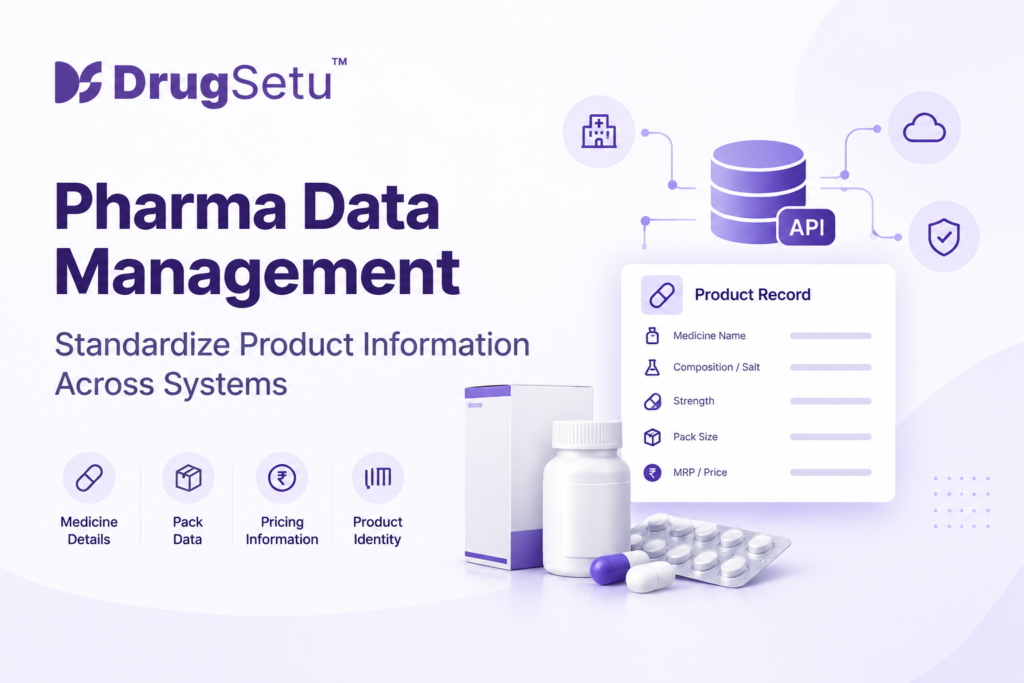
Pharma Data Management: How Pharmaceutical Companies Can Standardize Product Information
Access India's Medicine API
Integrate real-time, CDSCO-aligned medicine data into your healthcare platform.
Mention pharma data management and most people think of clinical trials, batch records or pharmacovigilance. Those matter, but there is a quieter layer that decides whether a medicine is found, priced and dispensed correctly: its product information. The brand name, salt composition, strength, pack size, MRP and status of every SKU you sell travel through a dozen systems and hands before they reach a pharmacist or a patient, and every handover is a chance for the record to drift.
This guide is written for regulatory, commercial, supply chain and IT teams at pharmaceutical companies in India. It explains what standardising product information really involves, the seven steps that work in practice, how Indian rules such as Schedule H2 and NPPA pricing change the picture, and how a shared Indian medicine dataset can take pressure off your internal team.
The short version
- Product information is master data. Treat it like a managed asset with an owner, a dictionary and an approval step, not like a spreadsheet.
- Standardise at the source. Fixing records after they leave your company is slower and never finishes.
- Use one golden record per product and pack, with a stable ID that survives name changes.
- Controlled values for dose form, units and salt names remove most downstream mismatches.
- Schedule H2 barcodes and QR codes, NPPA pricing and GS1 identifiers all depend on clean master data.
- Measure completeness, consistency and timeliness every month, and publish changes to all consumers from one place.
What is pharma data management?
Pharma data management is the set of policies, roles, processes and tools a pharmaceutical company uses to collect, validate, store, share and retire its data across research, manufacturing, regulatory, commercial and supply chain work, so that the data stays accurate, traceable and compliant throughout its life.
The phrase covers several different domains, and mixing them up is a common reason projects stall.
| Domain | Typical data | Main owners | Typical tools |
| Clinical and research data | Trial results, patient reported data | Clinical operations, biostatistics | CDMS, EDC |
| Manufacturing and quality data | Batch records, deviations, stability | Quality, production | LIMS, MES |
| Safety data | Adverse event reports | Pharmacovigilance | Safety databases |
| Product master data | Names, composition, strength, pack, price, status, codes | Regulatory, commercial, supply chain | PIM, MDM, ERP, shared databases |
This article is about the last row. It is the domain where the same product is described by more teams, in more systems, for more outside parties than any other, and the one where inconsistencies are most visible to the public.
Why product information is the weak link
Most large pharma companies have strong controls around batch and quality data, because regulators audit them. Product master data gets less attention because it looks simply. A product has a name and a price, after all.
In reality the same record is created and edited by many people:
- Regulatory affairs write it into licences, labels and submissions.
- Commercial and brand teams use it in catalogues, brochures and e-detailing.
- Supply chain and distribution use it for ordering, inventory and invoicing.
- Finance holds the price and tax details.
- IT holds the copy inside ERP, CRM and the sales force app.
- Outside parties hold their own copies: stockists, e-pharmacies, hospitals, aggregators, insurers and health apps.
When each group keeps its own version, you end up with what we call the five-name problem: one product appearing under five slightly different names across five systems. A 2019 survey by Pharma Manufacturing and Biovia found that close to 60 percent of respondents were still using Excel to aggregate and analyse process data. That study looked at process data and is dated, but the habit it describes is familiar in product data too.
What it costs you
- Wrong prices on the shelf. A price revision reaches your ERP in a day, your distributor in a week and an e-pharmacy catalogue in a month.
- Failed matches. A hospital pharmacy cannot map your product to its formulary because the composition is spelled differently.
- Substitution errors. Strength and pack variants of one brand get merged, or two different products get merged into one.
- Zombie listings. Discontinued products stay live online and generate complaints and returns.
- Rework in regulatory work. Teams rebuild the same product details for each submission, label update or tender.
- Slow launches. Every new SKU needs manual entry into several systems before it can be sold.
Why it matters more in India
India adds layers that make clean master data more than a nice-to-have.
Barcodes and QR codes on packs. Since 1 August 2023, manufacturers of the top 300 brands listed in Schedule H2 of the Drugs Rules, 1945 must print or affix a barcode or QR code on the primary label, or on the secondary label where space is short. The code must carry data that supports authentication. As reported in 2026, the Drugs (Seventh Amendment) Rules extend Schedule H2 to all vaccines, anticancer drugs, and narcotic and psychotropic substances from 1 July 2027, and to antimicrobials from 1 July 2028. Confirm exact scope and dates against the official CDSCO notification. Whatever the final text, the direction is clear: what is encoded on the pack has to match what is held in your master data.
Price control. NPPA fixes ceiling prices for scheduled formulations under the Drugs (Prices Control) Order, 2013, and for non-scheduled medicines the MRP cannot be raised by more than 10 percent in a 12-month period. Your price, GST and pack data must therefore be right, dated and traceable.
Counterfeit and quality pressure. CDSCO reported testing 96,713 samples in 2022 to 2023, of which 3,053 were declared substandard and 424 spurious or adulterated. Reliable product identity is part of how the supply chain tells a genuine product from a fake one.
A crowded brand landscape. Many companies market the same salt combination under different brand names, strengths and pack sizes. Without clear identifiers and consistent composition fields, downstream matching turns into guesswork.
Globally, the direction is the same. ISO IDMP, a set of five standards, defines how medicinal products, substances and packs are described and identified, with identifiers at the medicinal product, pharmaceutical product, pack, batch and substance levels. The EMA applies it through its SPOR master data services, and the FDA has run structured product labelling since the mid 2000s. GS1 positions its GTIN as the supply chain identifier that links to IDMP master data. India has no single mandated schema yet, but companies that export, or plan to, are already working with these ideas.
What a standardised product record looks like
There is no single approved Indian template, so most teams build a practical structure that follows CDSCO labelling, GS1 identifiers and IDMP concepts. A sound record separates what a product is from how it is packed and sold.
| Attribute group | Example fields | Why it matters |
| Identity | Internal product ID, brand name, GTIN or barcode, previous names | Stable matching across systems |
| Composition | Each salt as its own row, strength per salt, unit | Substitution, search, safety checks |
| Form and pack | Dosage form, route, pack size, pack type, units per pack | Ordering, billing, dispensing |
| Regulatory | Licence number, schedule (H, H1, H2, X), prescription status, marketing authorisation holder | Compliance and correct display |
| Pricing | MRP, GST rate, ceiling price status, effective date | Price control and billing |
| Lifecycle | Launch date, status (active, discontinued, recalled), status date | Prevents zombie listings |
| Media | Pack images, artwork version | Catalogue quality |
| Clinical text | Uses, side effects, warnings, with reviewer and date | Patient safety |
Three design choices matter more than the rest:
- Composition is structured, never free text. One row per salt, each with strength and unit, makes matching and search possible.
- A permanent ID. Names change. The ID must not.
- Every field has a date and an owner. A price without an effective date is a risk, not data.
Seven steps to standardise product information
Step 1: Audit where product data lives
List every system and file that holds product details: ERP, regulatory information system, CRM, sales force app, website, catalogues, distributor feeds, e-commerce listings, and the spreadsheets nobody admits to. For each, note who edits it, how often, and where it gets its values from. Expect surprises. Most companies find that the real source of truth for at least a few fields is a personal spreadsheet.
Step 2: Define the golden record and its owners
Choose one place where each attribute is created, and name an owner for it. Regulatory should own licence and schedule data, finance should own price and tax, supply chain should own pack and logistics data, and brand teams should own marketing content. The golden record is the approved combination of those fields. Everyone else consumes it, and nobody edits their copy.
Step 3: Write the data dictionary and controlled values
This step prevents most future mess. Document for every field its meaning, format, allowed values and an example. Then lock down the lists that cause the most trouble:
- dosage forms (tablet, film coated tablet, capsule, syrup, injection and so on)
- units (mg, mcg, ml, IU) and how they are written
- salt names, including a rule for salts, esters and hydrates
- pack types and how pack size is expressed
- capitalisation, abbreviations and special characters in brand names
Where possible, align with recognised vocabularies rather than inventing your own, because that makes later data sharing easier.
Step 4: Clean, match and de-duplicate existing records
Do this once, deliberately, and keep a log. Profile the data to find blanks, outliers and near duplicates. Match records across systems using the strongest key available, usually brand, composition, strength, form and pack size together, and a GTIN where one exists. Review ambiguous matches by hand. Resist automated merging for anything that touches composition or strength, where a wrong merge becomes a safety issue.
Step 5: Add validation and an approval workflow
Rules catch errors at entry, which is far cheaper than catching them later. Examples: composition cannot be empty, strength must have a unit, MRP cannot be lower than a defined floor, a discontinued product cannot have an open order, a price change needs a valid effective date. For fields with safety or regulatory impact, add a second person review before the record goes live. Keep a history of who changed what and when.
Step 6: Publish once, distribute everywhere
The golden record only helps if consumers actually use it. Set up one controlled path out: an internal API or feed for your own systems, a standard export for distributors and partners, and a link to shared databases that apps and pharmacies already query. Announce changes, for example price revisions or discontinuations, through the same path, with effective dates. When a downstream party asks for a special format, convert it from the golden record. Never edit by hand.
Step 7: Measure and maintain
Standardisation is a habit, not a project. Track a small set of measures every month and review them with the owners.
| Measure | What it tells you | Example question |
| Completeness | Share of records with all mandatory fields filled | How many SKUs lack strength or pack size? |
| Consistency | Same value in every system | Do ERP and the website show the same MRP? |
| Timeliness | Gap between a real change and its update | How many days after a revision did the price change? |
| Uniqueness | Duplicate or near duplicate records | How many products have two active IDs? |
| Accuracy | Match against the physical pack or label | Does a sample of 50 SKUs agree with the carton? |
Set your own targets based on risk. Fields that affect safety or price deserve a tighter standard than marketing text.
Who should own what
Data problems are usually ownership problems in disguise. A simple split works well.
| Team | Owns | Accountable for |
| Regulatory affairs | Licence, schedule, prescription status, label text | Legal accuracy |
| Quality assurance | Composition, strength, shelf life | Technical accuracy |
| Finance and pricing | MRP, GST, price effective dates | Price control compliance |
| Supply chain | Pack, GTIN, logistics data | Pack level accuracy |
| Commercial and brand | Descriptions, images, marketing text | Content quality |
| IT and data office | Platform, rules, access, audit trail | System integrity |
Name one data steward who runs the monthly review and has the authority to chase owners. Without that role the process decays within a year.
Build, buy or publish: choosing an approach
| Approach | Strengths | Limits |
| Spreadsheets and shared drives | Fast, no cost to start | No validation, no history, version chaos |
| Enterprise MDM or PIM platform | Strong governance, workflows, integration | Cost, long implementation, still internal only |
| Publishing to a shared industry database | Reaches pharmacies, apps and hospitals directly, avoids separate feeds | Depends on the platform’s review process and terms |
| Hybrid | Internal golden record plus one outbound channel | Needs clear sync rules |
For most Indian companies the hybrid route is the sensible one. Keep an internal golden record that matches your own governance, and publish approved records to a shared platform so that every downstream user sees the same version.
Mistakes that derail standardisation projects
- Starting with software before agreeing on definitions and owners.
- Trying to fix every field at once, instead of starting with the ones that cause the most downstream pain.
- Letting commercial teams edit composition or strength fields directly.
- Cleaning data once and never putting validation in place, so it degrades again.
- Ignoring discontinued products, which then keep circulating.
- Treating partner feeds as the master and your own system as the copy.
- Forgetting the physical pack. The artwork, the label and the record must agree.
A 90-day starting plan
Days 1 to 15: map. Run the audit, pick the 50 to 100 highest volume SKUs as a pilot, and name owners.
Days 16 to 45: define. Write the data dictionary, fix the controlled lists and design the golden record.
Days 46 to 75: clean and validate. Clean the pilot set, add validation rules and run the approval workflow on live changes.
Days 76 to 90: publish and measure. Connect one outbound channel, set up the monthly quality report and decide the rollout order for the rest of the portfolio.
A small pilot that works will win you more support than a large plan that has not started.
How DrugSetu helps pharma companies
DrugSetu is an Indian medicine database and API built around a CDSCO-aligned schema, with more than 5.99 lakh product records listed at the time of writing. Its approach is that the company which makes a product should be the one that publishes and maintains its information, with a review step before records go live and a history of changes afterwards. That gives you one place to maintain a product, while pharmacies, hospitals, health apps and e-pharmacies read the same record through the API.
To be clear about where things stand: the Pharma Dashboard for manufacturers is not yet released, and capabilities such as ATC codes, NLEM tagging, barcode and GTIN data and NPPA ceiling price are described as upcoming. If you want to understand how your own catalogue could be onboarded, or how data flows to the developers and pharmacies that rely on it, talk to the team. You can also read the use cases, see how the data is offered on the pricing page, browse the FAQ, or read our earlier piece on why India needs a unified medicine intelligence platform.
Frequently asked questions
What is pharma data management?
It is the way a pharmaceutical company controls its data from creation to retirement, covering clinical, manufacturing, safety and product information. Good practice means clear owners, defined standards, validation, an audit trail and controlled sharing with partners and regulators.
What is pharmaceutical master data?
It is the core, slow-changing information that describes what a company makes and sells: product names, composition, strength, form, pack, codes, licences, prices and status. Other systems refer to it rather than keep their own copies.
What does data standardisation mean in pharma?
It means describing every product in the same structure, with the same field names, units, allowed values and identifiers, in every system and for every partner. The goal is that one product always reads the same, wherever it appears.
Why is standardised product information important?
Because errors travel. A wrong strength, a spelling difference or an old price can lead to failed matches, wrong substitutions, billing disputes and patient safety issues. Standardised data also speeds up launches, audits and regulatory work.
What is IDMP and does it apply in India?
IDMP is a set of ISO standards for identifying and describing medicinal products, used mainly in Europe through the EMA. It has no direct legal force in India, but Indian exporters and multinationals often follow it, and its ideas of structured composition and unique identifiers are useful for domestic master data too.
What are the biggest pharma data management challenges?
Data silos, manual entry, inconsistent naming, unclear ownership, legacy spreadsheets, delays between a real change and its update everywhere, and the effort of sharing data in different formats with many partners.
Who should own product data in a pharma company?
Ownership should be split by field. Regulatory owns licence and schedule data, finance owns price and tax, quality owns composition, and supply chain owns pack data. A named data steward coordinates the process.
How do you clean legacy product data?
Profile the records, match them across systems using brand, composition, strength, form and pack together, review ambiguous matches manually, and fix the root cause with validation rules so that the same errors do not come back.
Which fields should an Indian medicine dataset include?
At minimum: a stable product ID, brand name, structured composition with strengths, dosage form, pack size, manufacturer, marketing company, MRP, GST, prescription category and status. Barcode or GTIN, schedule and ceiling price status make it far more useful.
Final thoughts
Standardising product information is not glamorous, but it quietly protects revenue, compliance and patients. Start small, give every field an owner, write down your definitions, and put validation where data enters. Then publish from one place so that everyone downstream sees the same truth.
Want to see how your portfolio could be represented and shared? Contact the DrugSetu team to start the conversation.
Disclaimer: This article offers general guidance on data practices and is not legal or regulatory advice. Rules such as Schedule H2 and NPPA pricing change, so confirm requirements against current official notifications from CDSCO and NPPA before acting.
Sources and further reading: CDSCO guidance on identification and verification of spurious drugs and the Schedule H2 notification; Drugs Rules, 1945 and amendments; National Pharmaceutical Pricing Authority and the Drugs (Prices Control) Order, 2013; GS1 position paper on GS1 and ISO IDMP; EMA SPOR documentation; Pharma Manufacturing and Biovia survey, 2019; reporting by Medianama, The Tribune and Mondaq on Schedule H2 expansion.