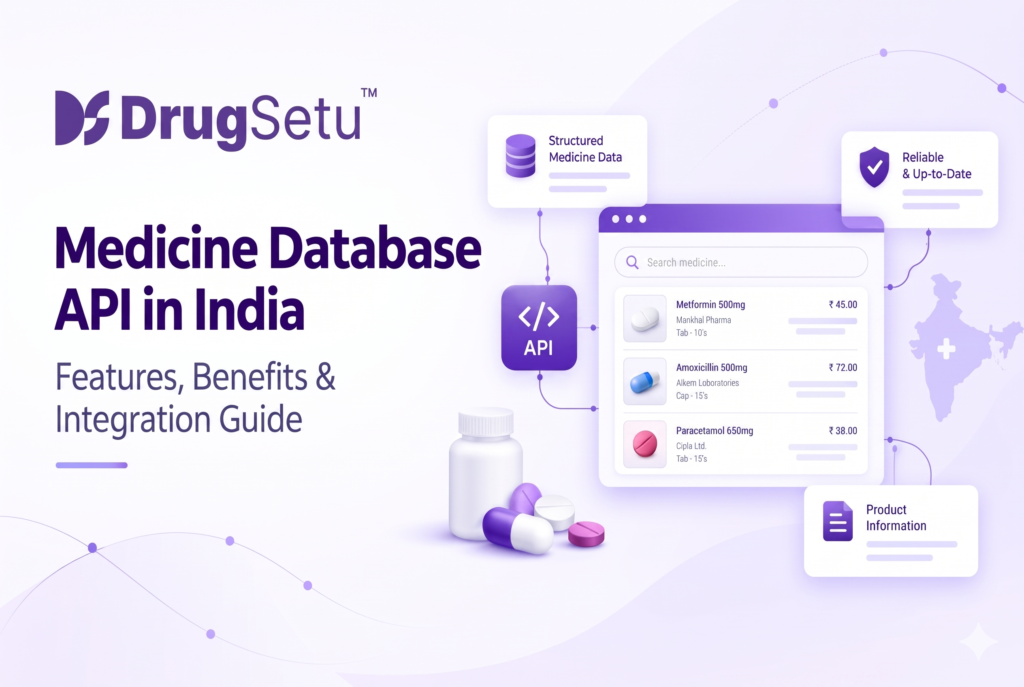
Medicine Database API in India: Features, Benefits and Integration Guide
Access India's Medicine API
Integrate real-time, CDSCO-aligned medicine data into your healthcare platform.
Anyone who has built a pharmacy app, a prescription tool or a hospital billing system in India knows the problem. The same tablet shows up under three spellings, two pack sizes and several manufacturer names, depending on where the data came from. Fixing that by hand never ends.
A medicine database API solves this by giving your software a single, structured source of medicine records that it can query on demand. This guide explains what such an API is, which features matter for Indian products, how to compare your options, and how to integrate one without creating new problems.
Quick Answer
A medicine database API is a web service that lets your application search and retrieve structured medicine data, such as brand name, salt composition, manufacturer, pack details and MRP, usually as JSON over HTTP. In India, the most useful ones map brands to generic compositions, stay current through manufacturer updates, and follow field structures that line up with CDSCO expectations.
What Is a Medicine Database API?
Think of it as a managed drug master list that your code can ask questions. Instead of maintaining a spreadsheet with hundreds of thousands of products and patching it every week, you send a request such as “find medicines containing Metformin” and receive clean, consistent records in return.
A typical record contains:
- Product ID and brand name
- Salt or composition, with strength
- Marketing company
- Pack size, quantity and dosage form
- MRP
- Product images
- Clinical fields such as uses, side effects, interactions and therapeutic class (depending on the plan)
Exact fields differ between providers, so always check the documentation before you design your database around them.
The API itself is simply the contract between your software and the data. If you want a refresher on the concept, the CDSCO page on Wikipedia is a useful starting point for understanding the regulator whose standards many Indian drug datasets try to follow.
Why India Needs a Local Approach
Sources built for other countries are excellent for their own markets, but they do not cover Indian brand names, Indian pack conventions or rupee pricing. A product built for Indian users’ needs data built around how medicines are actually named, packed and priced here.
Most teams end up choosing between four setups.
| Option | Strength | Risk |
| Free public datasets | No cost, fine for prototypes | Static snapshots, uneven fields, outdated prices, unclear licensing |
| Scraped or resold files | Large row counts | No update path, unknown origin, hard to defend in an audit |
| Government coding standards | Authoritative terminology | Focused on codes and interoperability rather than commercial fields like MRP or images |
| Commercial API | Maintained, versioned, supported | Subscription cost and vendor dependence |
Use free data to prototype. When money, patients or compliance are involved, choose a maintained source with a change history.
Features That Matter
Use this as a checklist when you evaluate any provider offering a drug database API or similar service.
- Source and ownership. Find out who creates the data. Records published and reviewed by pharmaceutical companies themselves are more dependable than records lifted from retail listings.
- Search that matches real behaviour. You need lookup by brand, salt and company. Pharmacists type quickly and misspell often, so test your hardest queries during any trial.
- Brand to generic mapping. This powers substitution, formulary checks and “cheaper alternative” features.
- Pricing fields. MRP is the minimum. Ceiling price, GST and batch level fields matter for billing and reconciliation, so confirm which are live today and which are still on a roadmap.
- Clinical depth. Uses, side effects, interactions and therapeutic class turn a simple lookup into a patient facing feature.
- Versioning and audit history. If a manufacturer corrects a composition, you should be able to see what changed and when.
- Rate limits and throughput. Know your peak traffic before choosing a plan.
- Public documentation and a real trial. You should be able to test with your own data before paying.
- Barcode and SKU matching. Valuable for pharmacy POS and inventory, but verify whether it is available now or planned.
Benefits for Different Teams
Health tech startups skip months of data cleaning and launch with a credible catalogue.
Online pharmacies get consistent listings, pack sizes and images across the storefront.
Hospital and EMR vendors align prescribing, billing and inventory around one drug master.
Insurers and TPAs validate claimed medicines against standardized records.
Analytics and research teams run pricing and market studies on structured data instead of messy exports.
Integration Guide: Step by Step
The flow below applies to most REST based providers. The endpoint and header in the sample follow DrugSetu’s public example, so confirm the current details in the documentation.
Step 1: Define the job. Write down the exact question your product needs answered. For example: “Show matching brands as the user types”, “Return alternatives with the same salt”, or “Validate a prescription line.”
Step 2: Get a key and test. Create an account, generate an API key and run a few queries. Test messy inputs such as misspellings, strength formats (“500” versus “500mg”) and combination drugs.
Step 3: Call the API from your backend. Keep the key on your server. Your front end talks to your own endpoint, and your server talks to the provider.
Step 4: Respect rate limits. Debounce search as users’ type (waiting around 300 milliseconds works well) and request only as many records as you need.
Step 5: Cache sensibly. Medicine records change infrequently, so caching popular lookups for hours or days saves cost and improves speed. Do not cache forever, because corrections and price changes do happen.
Step 6: Store the provider’s ID. Save the product ID alongside your own record. If names change later, your links stay intact.
Step 7: Handle zero and multiple results. Show a clear “no match” state and let users refine their search. In clinical flows, never silently pick the first of several matches.
Step 8: Monitor usage. Track errors, latency and monthly volume so you can upgrade before you hit a cap.
Step 9: Keep a human check where risk is high. API data supports decisions. It does not replace the judgment of a pharmacist or doctor.
Common Mistakes to Avoid
- Treating a free CSV file as production truth
- Matching on brand name alone, even though one brand can exist in several strengths
- Exposing the API key in browser code
- Forgetting that unused monthly requests usually do not roll over
- Skipping the trial, or testing only with clean sample inputs
What Does a Medicine API Cost in India?
Pricing varies by provider. As a reference point, DrugSetu publishes its plans openly:
- Free trial: 7 days, with starter level data and full documentation access
- Starter: ₹1,499 per month plus 18% GST, covering product ID, name, composition, marketing company, packaging, MRP and images (50K requests a month)
- Growth: ₹2,599 per month plus 18% GST, adding usage, benefits, side effects, interaction data and classification fields (100K requests a month)
- Add ons and custom plans for higher volumes
Sizing example: A pharmacy search feature with 2,000 monthly active users, each running about 20 lookups, makes roughly 40,000 requests a month. That sits inside the Starter allowance, and caching gives you additional headroom.
If you are comparing a medicine API India plan against building your own dataset, include the engineering time needed for cleaning, deduplication and ongoing updates in your cost estimate. That hidden cost is often larger than the subscription itself.
Can You Trust the Data?
Be wary of any vendor who claims their data is perfect. A more realistic approach is to reduce risk:
- Prefer sources where manufacturers own and update their own records
- Ask how corrections are handled and whether history is kept
- Compare a sample of about 50 medicines you know well against the actual packs
- Never treat API output as clinical advice
- Keep your own fallback process for records that look incomplete
Teams that need a dependable Indian medicine database API should also check how often records are reviewed and how conflicts between sources are resolved.
Choosing Between Product Data and Clinical Data
Many teams start with product records (names, packs, prices) and later add clinical content. A good drug information API should let you do exactly that without switching providers. Start with the fields your first release needs, then expand as your product matures.
Frequently Asked Questions
What is a medicine database API?
It is a web service that returns structured medicine information, such as names, compositions, manufacturers, pack details and prices, so your software does not depend on manual spreadsheets.
Is there a free medicine database API for India?
Free datasets and community projects exist, but they are usually static and incomplete. A free trial from a maintained provider is a safer way to test real workflows.
What is the difference between a drug database API and a drug information API?
The terms overlap. A drug database API usually focuses on product records such as brand, salt, pack and price. A drug information API leans toward clinical content such as interactions and side effects. Many providers offer both in tiers.
Which data fields should a medicine API include?
At minimum: product ID, name, composition, manufacturer, pack size, dosage form and MRP. For patient facing apps, add uses, side effects, interactions and therapeutic class.
How often is the data updated?
Ask every vendor directly. Look for review-based update workflows and a visible change history.
Can I use it in prescription software?
Yes, as a reference layer for search and matching. Final clinical decisions should always involve a qualified professional, and your own compliance obligations still apply.
Does the API support barcode lookup?
Check the provider’s roadmap. At DrugSetu, barcode and SKU matching is listed as upcoming, so confirm availability before planning a point-of-sale integration.
How do I get started?
Create an account, generate a key and run test queries against your real data.
Final Thoughts
Good medicine data is infrastructure. When it is clean and consistent, your search feels sharper, your billing reconciles, and your team stops spending weeks on spreadsheet repair. When it is not, every feature built on top inherits the problem.
Run your ten hardest queries through a trial, check the fields against your product needs, and size your monthly volume before committing. When you are ready, you can start a free trial and test the API with your own data.
Disclaimer: This article is for technical and informational purposes only. It is not medical, legal or regulatory advice. Please verify information against official sources before clinical or compliance use.