Indian Medicine Database: A Complete Guide to India’s All Medicine Name List
Access India's Medicine API
Integrate real-time, CDSCO-aligned medicine data into your healthcare platform.
If you are building a pharmacy app, a telemedicine flow, or a hospital billing system in India, you will hit the same wall within the first week. You need a clean, complete list of medicines, and every source you find disagrees with the others.
One file spells a brand as “Azithral 500”. Another says “Azithral 500mg Tab”. A third has no composition at all. Prices differ. Some rows describe products that left the market years ago.
This guide explains what an Indian medicine database really is, what a good one must contain, where the data usually comes from, and how to choose one for a production product. It is written for healthcare startups, developers, and online pharmacies who need to make a buying or building decision, not for patients looking up a single tablet.
Key Takeaways
- An Indian medicine database is a structured, searchable record of medicines sold in India, covering brand names, salt composition, strength, dosage form, manufacturer, pack size, price, and regulatory class.
- Free spreadsheets and scraped files are fine for a prototype. They become a liability in billing, prescriptions, and insurance claims.
- Judge any source on five things: coverage, freshness, ownership of the data, schema consistency, and how you will access it (file, API, or both).
- Do not confuse a medicine name list with a clinical formulary. One tells you what exists, the other tells you what is approved for use in a given setting.
- DrugSetu currently lists 5,99,941+ products in a CDSCO aligned schema, delivered through a REST API.
What Is an Indian Medicine Database?
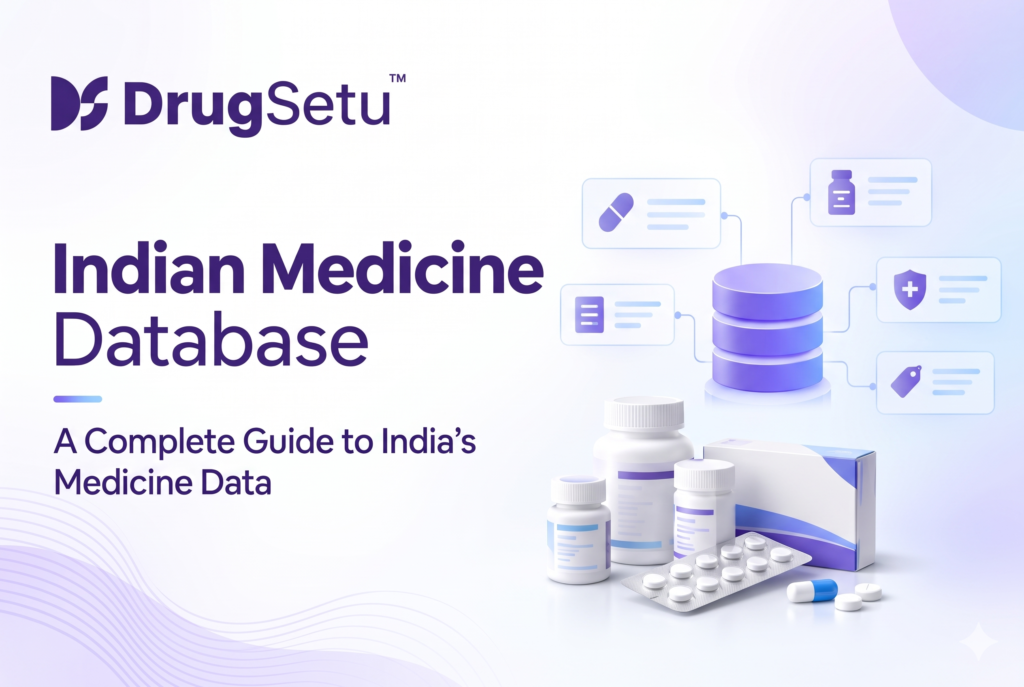
An Indian medicine database is a structured collection of records describing medicines available in the Indian market. Each record identifies a product by brand name and links it to its salt composition, strength, dosage form, manufacturer, pack size, price fields, and regulatory classification, so software can search, match, and validate medicines reliably.
People use several names for the same idea: all medicine name list, A to Z medicine name list, medicine index, Indian drug database, or simply list of medicines. The wording changes, but the need is identical. A single, consistent reference that every system in your stack can agree on.
A quick note on a common mix up. Search for this phrase and you will also find academic resources such as IMPPAT, OSADHI, and the Indian Medicinal Plants Database. Those catalogue medicinal plants, phytochemicals, and traditional formulations for research. They are valuable for natural product discovery, but they are not product level databases of branded tablets, syrups, and injections that a pharmacy would stock. This article is about the second kind.
Why India Needs a Standardized Medicine Database
India has one of the largest and most fragmented pharmaceutical markets in the world. The same salt can be sold under dozens of brands, in several strengths, by many manufacturers, in different pack sizes. When each hospital, pharmacy, and app keeps its own master list, small differences multiply into real operational problems.
- Billing mismatches. If a hospital pharmacy and an insurer name the same product differently, claims get flagged and reconciliation turns into manual work.
- Prescription ambiguity. A free text drug name can map to several products. A structured record with strength and form removes the guesswork.
- Stale catalogues. Products are launched, repackaged, repriced, and discontinued all the time. A static file starts decaying the day you download it.
- Migration friction. Moving from one pharmacy or hospital system to another is painful when the medicine master data cannot be matched one to one.
- Audit exposure. Digital health platforms are expected to show traceability. Unverified source data makes that hard to defend.
The government is working on the same problem from its side. The Ayushman Bharat Digital Mission has published a consultation paper on a national Drug Registry, which discusses unique drug codes and integration with SNOMED CT. The National Pharmaceutical Pricing Authority runs the Pharma Sahi Daam app so consumers can check prices and find substitutes, and its IPDMS 2.0 system handles submissions under the Drugs (Prices Control) Order, 2013. On the regulatory side, drug approvals in India sit with the Central Drugs Standard Control Organisation, which is why many data schemas align their fields to CDSCO conventions. Together these efforts show that standardized medicine data is becoming core digital infrastructure, not a nice to have.
What a Good Indian Medicine Database Should Contain
A list of names is not enough. For a product to be usable in a pharmacy, clinic, or claims workflow, each record should carry structured fields. Here is a practical checklist.
| Field group | Examples | Why it matters |
| Identity | Brand name, product ID, SKU or barcode (where available) | Unique matching and de duplication |
| Composition | Salt names, individual salt strengths | Generic substitution, interaction checks, search by salt |
| Form and strength | Tablet, capsule, syrup, injection, 500 mg, 5 ml | Prevents dosing and dispensing errors |
| Pack details | Strip of 10, bottle of 100 ml, units per pack | Inventory, billing, price per unit |
| Manufacturer | Company name, marketer if different | Brand comparison and compliance tracing |
| Pricing | MRP, PTR, GST percentage | Billing accuracy and margin analysis |
| Regulatory class | Prescription status, schedule, HS code | Sale rules, tax treatment, e commerce filters |
| Product category | Allopathic, AYUSH, OTC, nutraceutical, FMCG healthcare | Catalogue structure and search filters |
| Media | Verified pack images | Better listings and fewer wrong dispenses |
| Metadata | Version, last updated, change history | Trust, sync, and audit trail |
If a source skips more than two or three of these groups, expect to spend engineering time cleaning it yourself.
Medicine Name List vs Drug Formulary vs Drug Registry
These three terms are often used as if they were interchangeable. They are not, and picking the wrong one leads to the wrong build.
- All medicine name list or medicine index. A catalogue of products that exist in the market. Its job is identification and search.
- Drug formulary. A curated set of medicines approved for use in a specific hospital, insurer plan, or programme, often grouped by therapeutic area. Its job is selection and cost control.
- Drug registry. An authoritative, standards-based record with codes, typically maintained or governed at a national level. Its job is interoperability across systems.
Most products need the first one as a foundation, then layer a formulary on top for their own business rules. Insurers and TPAs, for instance, usually need both: a full catalogue to recognise a billed item, and a formulary to decide whether it is covered.
Where Indian Medicine Data Usually Comes From
Before you pick a source, understand how it was made. The origin decides how much you can trust it.
- Free datasets and open repositories. Public datasets on platforms like Kaggle contain tens of thousands of rows with fields such as product name, salt composition, price, manufacturer, description, side effects, and interactions. One popular example lists roughly 195,000 rows across eight columns, and its own author warns that price should be treated only as a reference because it changes frequently. These are great for learning and demos.
- Freelance and marketplace data packs. Some sellers offer spreadsheets of roughly six lakh medicines with many descriptive columns. The coverage can look impressive, but the provenance is rarely documented, and updates depend on one individual.
- Scraped catalogues. Data collected from consumer pharmacy websites is easy to produce and hard to keep consistent. It inherits the errors, formatting quirks, and legal terms of the site it came from.
- Distributor or retailer catalogues. Accurate for what a distributor sells, but incomplete for the wider market and shaped by commercial priorities.
- Government and regulatory lists. Authoritative for what they cover, such as ceiling prices of scheduled medicines, but they are not designed as a complete, developer ready catalogue of every branded product.
- Manufacturer sourced data layers. Here the pharmaceutical company itself publishes and maintains its product records, and the platform normalizes them into one schema. This approach attacks the root cause of inconsistency, because the data starts at the source.
How to Evaluate an Indian Medicine Database: A Five-Point Test
Use this before you sign anything or write a single line of integration code.
- Coverage. How many products, and across which categories? Ask whether prescription, OTC, AYUSH, and nutraceutical items are included, and whether discontinued products are flagged or silently dropped.
- Freshness. How often are records updated, and can you see a change history? A database with no versioning cannot be audited.
- Source and ownership. Who creates the record, and who is accountable if it is wrong? Scraped data has no accountable owner.
- Schema quality. Are salts split into separate fields with strengths? Are units consistent? Is there a stable product ID that does not change when a name is edited?
- Access method. Can you query it live through an API with predictable JSON, or are you stuck re importing spreadsheets every month?
A sixth question matters for commercial products: licensing. If you plan to resell, embed, or display the data to end users, confirm in writing that your use is permitted. This is a point to settle with a legal advisor before launch.
File vs API: Which Should You Choose?
| Factor | Downloaded file (CSV or XLS) | Medicine database API |
| Setup speed | Fast for a prototype | Fast with an API key |
| Freshness | Frozen at download date | Updated continuously |
| Maintenance | You own cleaning and refresh jobs | Provider owns it |
| Storage | You host millions of rows | You query on demand |
| Search quality | You build fuzzy search yourself | Search by brand, salt, or company is built in |
| Audit trail | Usually none | Version history available |
| Best for | Research, demos, one time analysis | Pharmacies, EMR, claims, telemedicine in production |
A sensible path for many teams: prototype with a free file, then move to an API before real patients or real money touch the system.
Use Cases by Audience
Online pharmacies. Consistent product titles, pack sizes, and price fields make catalogue upload and updates far faster. Verified images reduce customer complaints about receiving the wrong pack.
Telemedicine and health apps. Doctors need to pick the exact product while prescribing. Structured strength and form fields reduce ambiguity, and salt level search supports generic suggestions.
Hospitals and clinics. One master list across EMR, pharmacy, inventory, and billing cuts reconciliation work between departments.
Insurers and TPAs. Standard records allow claim items to be validated against known products and formulary rules.
Analytics and research teams. A consistent dataset supports pricing studies, market analysis, and pharmacovigilance projects without weeks of cleaning.
Where DrugSetu Fits
DrugSetu is built as a uniform medicine data layer for India. It lists 5,99,941+ products, uses a CDSCO aligned field structure, and is designed as an API first platform for developers, pharmacies, hospitals, insurers, and digital health apps. Developers can search medicines by brand name, generic name, salt composition, or manufacturer through REST endpoints that return JSON.
What makes the approach different is where the data comes from. Instead of scraping websites or copying distributor sheets, DrugSetu is designed so pharmaceutical companies publish and maintain their own verified product records, with review gates and a full audit history before updates go live.
To set honest expectations, a few capabilities are still on the roadmap. The pharma company dashboard is not yet publicly released, barcode and SKU matching is listed as upcoming, and product batch details are marked as coming soon. If any of these are essential to your launch, ask the team about timelines before you commit.
To see how access is structured, check the plans for the Indian drug database API, and test the endpoints in the sandbox before you commit. For background on why a shared data layer matter, read Why India Needs a Unified Medicine Intelligence Platform Like DrugSetu.
Common Mistakes When Choosing a Medicine Database
- Buying on row count alone. Six lakh rows of inconsistent data is worse than three lakh clean ones.
- Ignoring duplicates. The same product listed under three spellings will break search and inventory matching.
- Treating price as permanent. MRP can change. Always read price as a dated field, and check regulated ceiling prices where they apply.
- Using descriptive text as clinical advice. Patient information fields such as uses and side effects belong to content, not to dispensing logic. Rely on qualified clinical sources for medical decisions.
- Skipping legal review. Data scraped from a third-party site can carry restrictions that surface only after you launch.
- Hard coding the name as the ID. Names change. Stable identifiers do not.
A Quick Integration Checklist
- Define the exact fields your product needs before looking at any provider.
- Request sandbox access and run at least 50 of your real, messy product names against it.
- Measure match rate, response time, and how misspellings are handled.
- Confirm update frequency and how changes are communicated.
- Read the licensing terms for display, storage, and resale.
- Plan a fallback for products that return no match, such as a manual review queue.
- Schedule a monthly check of match rates after launch.
Frequently Asked Questions
What is an Indian medicine database?
It is a structured, searchable collection of medicines sold in India, with fields such as brand name, salt composition, strength, dosage form, manufacturer, pack size, price, and regulatory class. Software uses it to identify and validate medicines consistently.
How many medicines are there in India?
No single official count exists, because brands, strengths, and pack sizes multiply the numbers and products change constantly. Different databases report different totals depending on how they count. DrugSetu currently lists 5,99,941+ products.
Where can I get an all-medicine name list for India?
Options include free datasets for prototypes, government price lists for regulated medicines, and commercial databases or APIs for production use. Choose based on coverage, freshness, data ownership, and licensing rather than price alone.
Is there a free Indian medicine database I can download?
Yes, community datasets exist and are useful for learning or testing. They are usually static, can contain gaps, and may not be cleared for commercial use. For live products, a maintained API is the safer route. DrugSetu offers sandbox access so you can test before committing.
What is the difference between a medicine database and a drug formulary?
A medicine database lists products available in the market. A formulary is a curated subset approved for a specific hospital, insurer, or programme. Most organisations need the database first, then build a formulary on top.
What is an A-to-Z medicine name list used for?
An A to Z medicine name list works as an alphabetical index that supports search, autocomplete, catalogue building, and inventory matching. A useful one goes beyond names and includes composition, strength, and manufacturer.
How do I check the official price of a medicine in India?
The National Pharmaceutical Pricing Authority publishes ceiling prices for scheduled medicines under the Drugs (Prices Control) Order, 2013, and its Pharma Sahi Daam app lets consumers compare prices and look up substitutes. For software products, use a database with a dated price field and refresh it regularly.
Does a medicine database include Ayurvedic and AYUSH products?
Some do and some do not. Always check whether AYUSH, OTC, and nutraceutical items are covered if your catalogue includes them. DrugSetu’s scope includes prescription medicines, OTC and FMCG products, generics, branded medicines, AYUSH products, and nutraceutical SKUs.
Can I use an Indian medicine database for an online pharmacy?
Yes, that is one of the most common uses. Look for consistent naming, pack size data, verified images, and a way to receive updates automatically. Also confirm that your platform meets the licensing and regulatory requirements that apply to online sale of medicines in India.
What should developers look for in a medicine database API?
Predictable JSON responses, search by brand, salt, and company, stable product IDs, versioned updates, clear documentation, sandbox access, and acceptable response times. Test it with your own real world product names before you integrate.
Final Thoughts
A medicine database is easy to underestimate. It looks like a spreadsheet problem until the first billing mismatch, the first wrong dispense, or the first failed audit. Treat it as infrastructure from day one, pick a source whose origin you can explain to a regulator, and test it against your own messy data before you trust it.
If you are evaluating options for your pharmacy, app, or hospital platform, test any provider with your own product names first. And if you want to see how DrugSetu handles your use case, talk to the DrugSetu team.
Disclaimer: This article is for general information about data infrastructure and is not medical, legal, or regulatory advice. Medicine information in any database must not replace the judgment of a qualified doctor or pharmacist. Confirm licensing and compliance requirements with a qualified advisor before launch.